You’ve got a logo you love.
It looks sharp on your website, business cards and invoices. The colours are perfect, the small details are crisp, and the text is easy to read.
Then you put that same logo on a shirt, and suddenly, it doesn’t look quite the same.
What happened?
The problem usually isn't your logo. It's that artwork designed for digital or print use doesn't always translate directly to clothing decoration.
Fabric, thread, embroidery machines and printing processes all have different limitations. A good result often depends on preparing and optimising your artwork specifically for the garment and decoration method you're using.
Here are some of the most common reasons your logo can look different on clothing.
A logo can look incredibly detailed on a computer screen because the artwork can be displayed at a very high resolution.
Clothing is different.
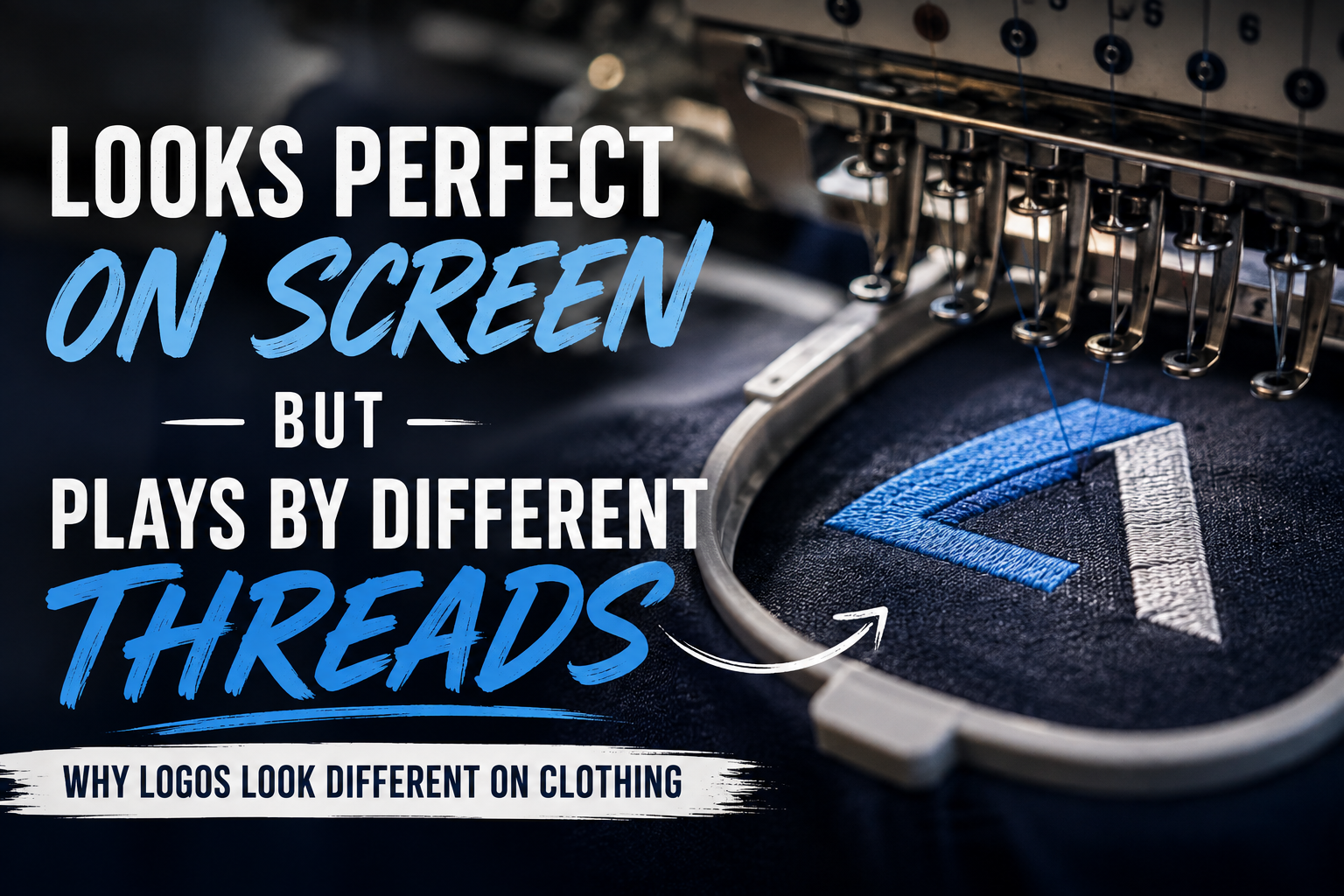
When a logo is embroidered, for example, tiny elements have to be translated into individual stitches. Very fine lines and small details may not reproduce exactly as they appear in the original artwork.
This is particularly important for:
Fine lines
Small symbols
Tiny gaps between elements
Very small lettering
Intricate patterns
Something that looks perfectly clear on screen may become crowded or difficult to distinguish when reproduced on fabric.
The solution isn't necessarily to redesign your entire logo. Often, the artwork can be adjusted or simplified specifically for clothing decoration.
Embroidery isn't simply a matter of taking your logo file and "stitching" it onto a shirt.
Your artwork needs to be digitised, converted into a format that an embroidery machine can understand.
During this process, the artwork is broken down into stitches, thread directions and different sections.
The more detailed the design, the more complex the embroidery can become.
A high stitch count can affect:
Production time
The level of detail that can be reproduced
How the design sits on the garment
The overall appearance of the finished embroidery
That's why an embroidery-ready version of your logo may look slightly different from the original digital artwork.
The goal is to preserve the important visual elements of your brand while making sure the design works properly with thread and fabric.
One of the most common issues we see with logos on clothing is small text.
Your business name or tagline might look perfectly readable when your logo is displayed on a large computer monitor.
But when that same text is reduced to fit on the chest of a polo shirt, there may simply not be enough space to reproduce every letter clearly.
With embroidery especially, very small lettering can become difficult to read because each character needs to be built from thread.
In some cases, the best solution is to:
Increase the text size
Remove unnecessary small text
Use a simpler font
Create a simplified version of the logo for uniforms
This doesn't mean your original branding is wrong. It means different applications may require different artwork versions.
Gradients can look fantastic in digital artwork.
A smooth transition from one colour to another is easy to display on a screen.
But not every clothing decoration method can reproduce a gradient in exactly the same way.
Embroidery uses physical thread colours rather than pixels, so a smooth digital gradient may need to be interpreted differently.
Depending on the decoration method, gradients may need to be simplified, reproduced using available colours or handled through a different printing technique.
This is one reason it's important to discuss how your logo will be decorated before finalising the artwork.
There isn't one decoration method that is perfect for every logo.
Embroidery is excellent for creating a professional, textured finish and is commonly used on polos, jackets, workwear and caps. However, very fine details, tiny lettering and complex artwork can require adjustments.
Printed decoration, on the other hand, can be better suited to artwork with fine details, larger designs, photographic elements or effects that aren't practical to reproduce with thread.
The right option depends on your:
Logo
Garment
Design size
Number of colours
Level of detail
Desired finish
Where the logo will be placed
The best decoration method isn't necessarily the one you've used before. It's the one that gives your particular artwork the best result on the particular garment you're ordering.
Even a perfectly prepared logo can look wrong if it's placed in the wrong position or at the wrong size.
For example, a logo designed to look great across the front of a hoodie may not work at the same size on the left chest of a polo.
Placement can affect:
How large the artwork should be
How much detail can be retained
How the design sits on the garment
How easily the logo can be seen
The overall balance of the uniform
A design that looks fantastic on a screen doesn't necessarily tell you what size it should be on an actual garment.
That's why artwork, garment selection and decoration should be considered together.
This is where artwork preparation becomes especially important.
Before production, artwork may need to be adjusted to suit the selected decoration method. This can include simplifying details, adjusting sizing, preparing colours, changing elements or creating a suitable production file.
For embroidery, the artwork needs to be properly digitised.
For printed decoration, the artwork may need to be prepared according to the requirements of the chosen printing process.
Good artwork preparation isn't about changing your brand. It's about helping your brand look its best in a different medium.
One of the biggest mistakes businesses make is assuming that one logo file should work perfectly everywhere.
Your logo may need different versions for:
Websites
Social media
Business cards
Signage
Embroidery
Printed uniforms
Promotional products
The core brand remains the same, but the artwork may need to be adapted for the application.
Think of it like this:
Your digital logo is designed to be viewed. Your uniform logo is designed to be reproduced on a physical material.
Those are two very different environments.
Before sending your logo off for production, consider:
How will the logo be decorated? Embroidery and printing have different requirements.
How large will the logo be? A design that works at one size may not work at another.
Does it contain tiny text? Small lettering may need to be enlarged or simplified.
Does it contain gradients? Your chosen decoration method may affect how they are reproduced.
Are there very fine details? These may need to be adjusted for fabric.
Where will the logo be placed? Chest, sleeve, back and other locations can require different sizing.
Is the artwork production-ready? The original logo file may need optimisation before production.
A little preparation before you order can make a significant difference to the finished result.
Your logo represents your business, so it's worth making sure it looks just as professional on your uniforms as it does everywhere else.
The good news is that you don't necessarily need to redesign your branding.
You simply need to make sure your artwork is prepared for the way it will actually be used.
At Fully Promoted Moonee Valley, we can help you work through the practical considerations of your logo, garment and decoration method before production begins.
Planning new branded uniforms? Get in touch with Fully Promoted Moonee Valley to discuss your artwork and find the right decoration option for your team.
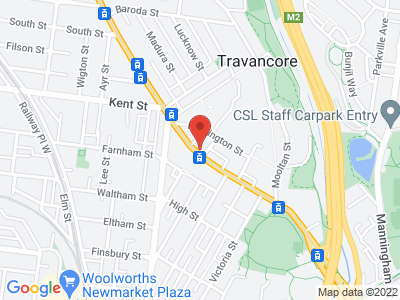
Fully Promoted Moonee Valley
178 Mt Alexander Road
Travancore Victoria 3032



By Appointment For Wednesdays & Saturdays
Opening Hours:Create exactly the look you want with a variety of branding options. Our experts can help you discover which techniques will best represent your brand and your budget.
Whether it’s embroidery for your garments, screen printing for a run of apparel, or the latest in branding technology with direct to transfer printing, Fully Promoted has you covered.
Contact Fully Promoted today.





Join our winning team and own your future with
Fully Promoted - the largest promotional franchise
in Australia.
Apply Today!
>



 Industries