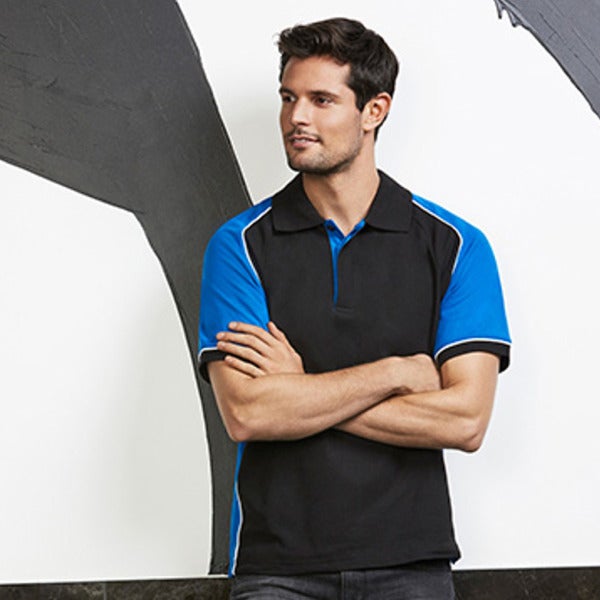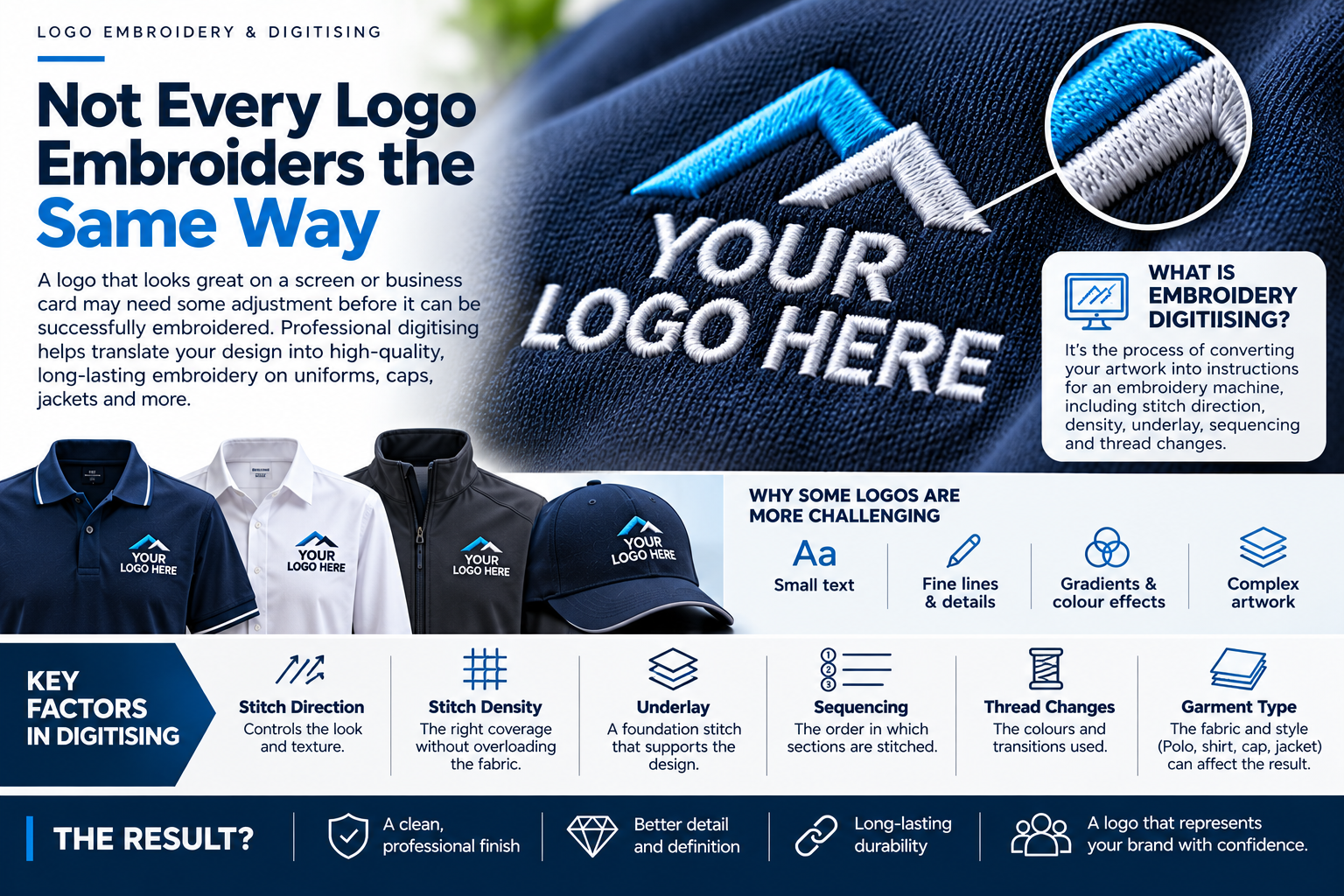
Your company logo might look perfect on your website, business cards or signage. But will it look just as good embroidered on a polo shirt, jacket or cap?
Not necessarily.
Embroidery is a completely different process from digital printing. What looks sharp on a screen may require careful adjustments before it can be reproduced accurately using thread.
Very small text, fine lines, gradients and intricate details can all present challenges.
That doesn't mean your logo needs to change. It means your design needs to be properly prepared for embroidery.
At Fully Promoted Pyrmont, we understand that professional embroidery starts long before the first stitch.
Embroidery digitising is the process of translating artwork into instructions that an embroidery machine can follow.
It is not simply converting a JPG, PNG or PDF into another file format.
A digitised embroidery design contains information about how the logo should be stitched, including:
Stitch direction: How threads are positioned to create shapes and details
Stitch density: How closely the stitches sit together
Underlay stitching: The foundation stitches supporting the visible embroidery
Stitch sequencing: The order in which different sections are embroidered
Thread changes: The colours required to reproduce the design
Fabric compensation: Adjustments to account for how material moves or pulls during stitching
Each of these decisions influences the finished appearance.
Poor digitising can result in distorted lettering, uneven edges, fabric puckering or embroidery that feels unnecessarily thick and stiff.
Good digitising takes the garment, artwork and intended embroidery size into consideration.
Not all artwork translates naturally into thread.
A simple company logo with bold lettering and defined shapes is generally easier to reproduce than a design containing several intricate elements.
Very small lettering can become difficult to read once embroidered.
Letters need sufficient space for the stitches to form clearly. If the text is too small, individual characters may begin to merge.
Sometimes the answer is to increase the embroidery size. Other times, an approved simplified version of the logo may produce a better result.
Thin outlines, delicate illustrations and tiny design elements can lose definition when translated into stitches.
The digitising process needs to account for the physical width of the thread and the limitations of the embroidery machine.
Digital artwork can reproduce thousands of colours and smooth gradients.
Traditional machine embroidery uses individual thread colours, so photographic effects and complex gradients cannot always be recreated exactly.
A carefully selected thread palette or approved design adjustment may help retain the important elements of the original artwork.
The goal is to preserve the identity of the brand while producing embroidery that looks clean and professional.
A logo that embroiders beautifully on a heavyweight cotton polo may require different preparation when applied to a lightweight performance shirt.
Fabric construction affects how stitches sit, how much the material moves and how much support is needed.
Cotton and polyester polos have different fabric structures and stretch characteristics.
Lightweight polos may require careful stabilisation to avoid puckering around the design.
Business shirts can be made from relatively fine woven fabrics.
Excessive stitch density may create visible pulling or distortion, particularly around smaller logos.
Jackets may contain multiple fabric layers, linings and specialist coatings.
These need to be considered when choosing embroidery placement, backing and stitch construction.
Caps introduce additional challenges because of their curved shape, seams and structured or unstructured panels.
A logo prepared for a flat shirt may need to be adjusted for embroidery on a cap.
This is why having a digitised file does not automatically guarantee the same result across every garment.
More stitches do not necessarily mean better embroidery.
If stitches are placed too closely together, the design can become thick, stiff or distorted.
On lightweight fabrics, excessive density can also contribute to puckering.
If the stitches are spaced too far apart, the garment may show through the embroidery or the design may appear uneven.
The correct density depends on the artwork, thread, fabric and stitch type.
Professional digitising aims to achieve good coverage without unnecessarily overloading the material.
Underlay is the foundation beneath the visible embroidery.
Although it is usually hidden, it helps support the design and control fabric movement.
Different designs require different forms of underlay.
For example, small lettering may need a different foundation from a large filled logo.
The right underlay can help improve edge definition, stitch coverage and the overall appearance of the embroidery.
However, too much underlay can also create unnecessary bulk.
It is another reason that embroidery preparation requires more than automatic file conversion.
An embroidery design can look excellent in digitising software but behave differently once stitched onto fabric.
A test embroidery, often called a stitch-out, provides an opportunity to inspect the physical result.
It can reveal issues such as:
Small lettering that is difficult to read
Uneven stitching
Fabric puckering
Gaps in the design
Unwanted stiffness
Misaligned outlines
Thread colour differences
Where necessary, adjustments can be made to the digitised file before proceeding with production.
For detailed logos, unfamiliar fabrics or large uniform orders, this extra attention can make a significant difference.
Not necessarily.
Once a logo has been correctly digitised, the embroidery file can often be reused for future orders.
However, a new setup or adjustment may be required when:
The logo size changes significantly
The design is transferred from a polo to a cap
A different fabric requires changes to the stitching
Small lettering needs adjustment
The original embroidery file was poorly prepared
A different logo variation is required
For businesses with recurring uniform orders, maintaining approved embroidery files and specifications can help improve consistency.
One of the most common mistakes is assuming that a logo can simply be reduced or enlarged without affecting the stitching.
Unlike a digital image, embroidery contains physical stitches.
If a design is reduced significantly without adjusting the stitch structure, the threads may become overcrowded.
If it is enlarged too much, gaps or uneven coverage may become visible.
That is why embroidery sizing should be considered during digitising, not treated as a simple scaling exercise.
For businesses ordering multiple garment styles, it may be appropriate to prepare different versions for chest logos, caps and larger applications.
Embroidery is an excellent choice for many corporate uniforms, but it is not always the best method for every design.
If a logo contains extremely fine lettering, photographic effects, intricate gradients or large areas of detailed artwork, a printed transfer may offer a more suitable result.
Similarly, very lightweight garments may be better suited to printing when dense embroidery would affect comfort.
At Fully Promoted Pyrmont, we help clients consider the available options, including embroidery, DTF printing and other suitable decoration methods.
The objective is not to recommend embroidery for every garment.
It is to choose the technique that best represents the artwork and suits the product.
At Fully Promoted Pyrmont, we believe embroidery quality begins with understanding the client's branding.
We take time to review the artwork, the garment being used and the intended logo placement before proceeding with production.
Our embroidery approach considers:
Artwork suitability and digitising requirements
Stitch density and construction
Logo size and proportions
Fabric compatibility
Thread colours and PMS references
Placement and alignment
Sampling and artwork approval where appropriate
Consistency across repeat orders
With our embroidery equipment, production experience and specialist resources, we work to achieve clean, professional results across business uniforms, corporate apparel, caps, jackets and workwear.
When a design presents challenges, we explore suitable adjustments rather than simply accepting a poor embroidered result.
For us, the goal is not just to reproduce a logo.
It is to ensure that the embroidered version represents the business as professionally as the original design.
Whether you need embroidered polos for your employees, corporate shirts, branded jackets, caps or a complete uniform range, Fully Promoted Pyrmont can help.
Read more about our professional embroidery services and uniform branding.
You can also contact Fully Promoted Pyrmont to discuss your logo, digitising requirements and garment selection.
Because great embroidery is not just about the stitches you see. It's about the preparation behind every stitch.

Fully Promoted Sydney CBD South
Shop 2, 209 Harris Street
Pyrmont New South Wales 2009
Create exactly the look you want with a variety of branding options. Our experts can help you discover which techniques will best represent your brand and your budget.
Whether it’s embroidery for your garments, screen printing for a run of apparel, or the latest in branding technology with direct to transfer printing, Fully Promoted has you covered.
Contact Fully Promoted today.












Join our winning team and own your future with
Fully Promoted - the largest promotional franchise
in Australia.
Apply Today!
>



 Industries